
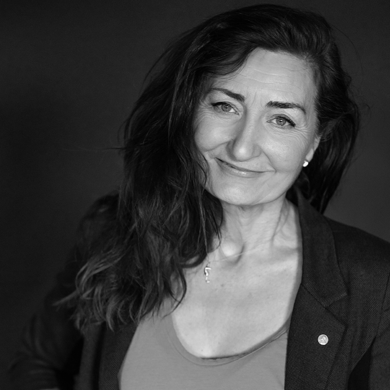
May Britt Moser
2014 Nobel Laureate
Professor and Co-Director
Kavli Institute for Systems Neuroscience
Dr. Moser investigates the neural basis of cognition, with a particular focus on space, time, and memory. Working in close collaboration with Edvard Moser, her research has included the discovery of grid cells and other spatially tuned neurons. With the recent development of methods for monitoring and perturbing activity in thousands of functionally identifiable neurons during behavior, Dr. Moser’s work has increasingly centered on how large neural populations encode spatial position, temporal structure, and memory. These approaches enable her to study neural dynamics at fine temporal scales, leading to our discovery of a toroidal manifold underlying grid-cell population activity—a structure that remains stable even during sleep.
Dr. Moser received her initial scientific training at the University of Oslo under Per Andersen, followed by postdoctoral work in the U.K. with Richard Morris and John O’Keefe. In 1996, she joined the faculty at NTNU and became a professor in 2000. Together with Edvard Moser, Dr. Moser founded the Centre for the Biology of Memory (2002), the Kavli Institute for Systems Neuroscience (2007), the Centre for Neural Computation (2013), and the Centre for Algorithms in the Cortex (2023), all established as Centres of Excellence funded by the Research Council of Norway. She served—and continue to serve—as Director of the latter two centres.
Dr. Moser’s work has been recognized with numerous international awards, including the 2014 Nobel Prize in Physiology or Medicine, shared with Edvard Moser and John O’Keefe. She has more than 100 peer reviewed publications, including 27 original research papers in Nature and Science, with a comparable publication rate in recent years (including one paper in each journal in 2025). All publications originate from her own laboratory. Dr. Moser’s h index is approximately 85, with more than 50,000 citations excluding self citations (Google Scholar). The 2005 Nature paper by Hafting et al., which contributed to the Nobel Prize, had 5347 citations as of February 25, 2026. Dr. Moser has supervised 35 PhD students and 46 postdoctoral researchers, with 10 PhD students and 12 postdocs currently in training.